






Why is the difference between B2B and B2C more relevant today?
The key difference between B2B and B2C is typically the volume.
In B2B you have more human, face-to-face relationships with your customers, you connect on a one-on-one basis. In some cases it might be five or 10 to one – but there's still a connection and a relationship.
It's that modern, value selling-based approach. But the B2C world it's different.
Traditional sales funnel: B2C
In B2C, it's usually a volume game. From stores selling shoes, to supermarkets selling you shampoos, toys, and games.
The business is directly selling to mass consumers, and as a result there's not necessarily a personalized level of connection with the customer.
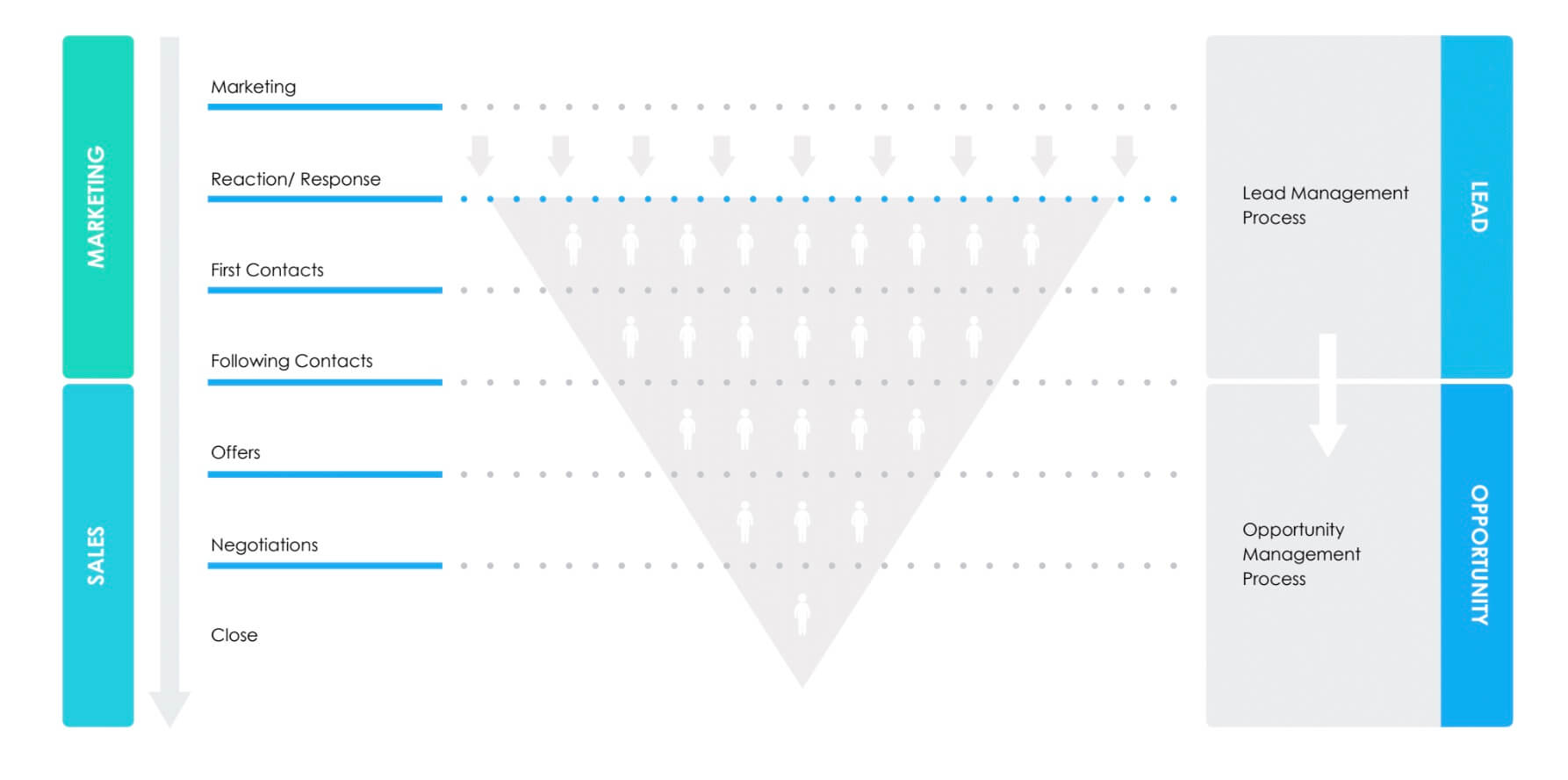
Of course, there are a lot of things happening on the marketing side and at the brand level to create a sort of mass connection to certain segments of potential customers.
But when it comes to selling on the ground, the salesperson at let's say at the shoe store, won't necessarily have an individual connection with every customer they sell to.
For them, it's selling to one customer, and then moving on to the next one.
That's the volume game I'm talking about.
But when you look at that analogy of a shoe store and compare it to today's age of digital companies – especially the big ones, like Facebook, Google, Instagram, Tik Tok – we see a difference.
There are massive amounts of free users, but the paid users, the actual customers, are just a select few from those masses.
Traditional customer flow: B2C
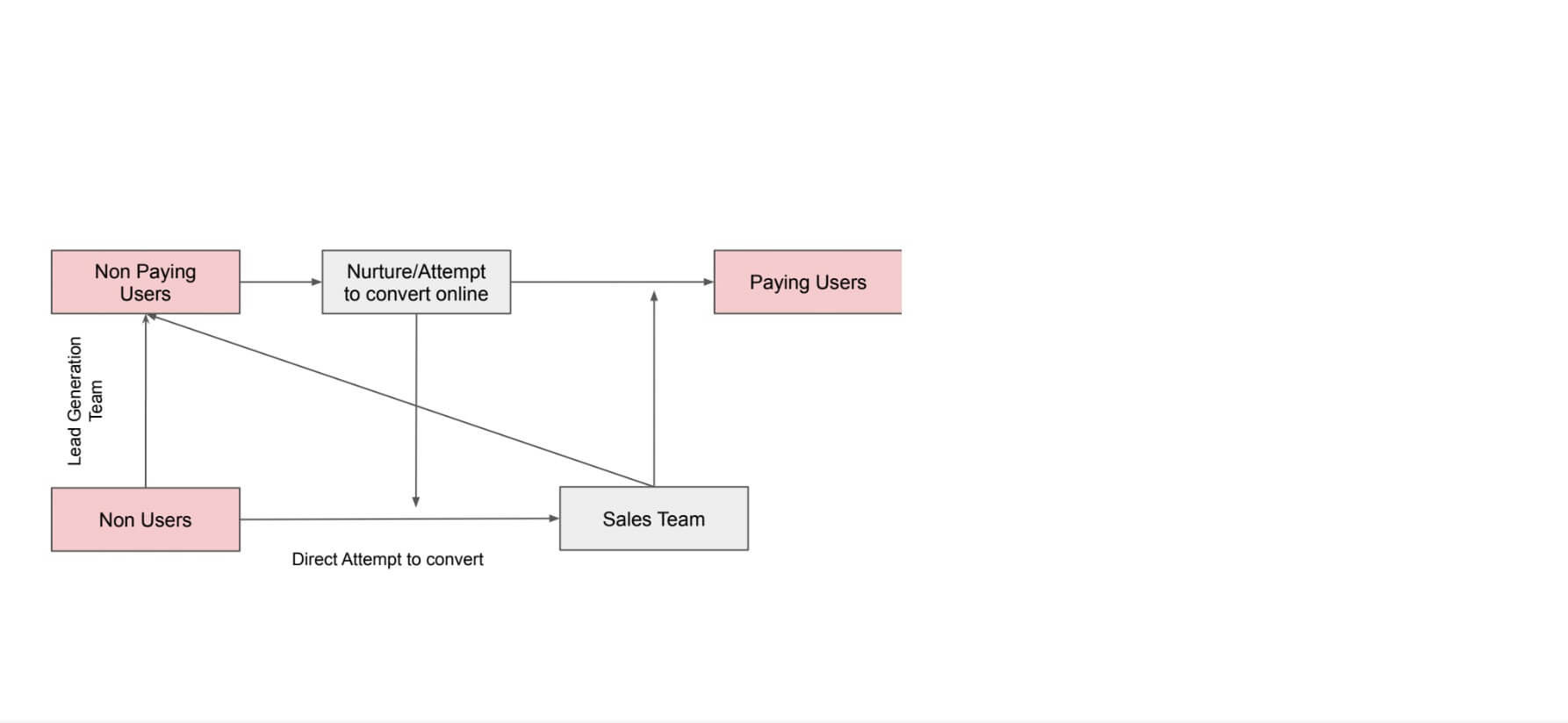
As soon as you have a product or service that's aligned with market you're working in, marketing teams, campaign teams, or lead generation teams will run mass digital campaigns, in-person events, and more.
Typically, that'll translate into leads.
There's a level of interest that comes from that first step, which then gets converted into a database of contacts and passed on to either a digital or automated sales engine, or in certain cases to actual salespeople.
Example: LinkedIn
I'm sure most people reading use LinkedIn, and inevitably see emails from LinkedIn advertising their value-added services or paid subscriptions.
When you click on that email and pay for that service, then you become a customer. That's the digital sales aspect that comes after marketing, to which I referred to above.
Here, there's no interaction with the salesperson – it's the typical B2C format.
Traditionally, this has been how B2C has worked. In short, it looks like this:
- Non-users become users of a free version (LinkedIn, Tinder, Carousell, whatever)
- They then move from free users to using value-added services through digital selling or marketing campaigns – and become paid users
You can also have salespeople involved, especially if you're a SMB-level organization or a specialist in certain areas. You may even have salespeople reach out one-on-one in an effort convert a free user into a paid user.
 Alex Walton
How do you change this model now?
With Covid and economic instability, the raw volume is starting to dry out in many industries.
How do you change the way you go to market in B2C sales to focus on making your customers more successful?
It’s not rocket science, nor is it something that's new.
How to make customers and sales succeed together
It's about taking a page from the B2B book, but thinking about approaching it from a B2C perspective – how do you help customers succeed?
This doesn't mean just throwing more bodies at the problem or hiring more salespeople. How do you repurpose what you do have, to make your customers more successful?
You want to make customers more successful is because that will eventually translate into more revenue for you.
Below are three high-level things we've been testing for the last two-to-three quarters which are providing very good results – hopefully you'll find some value in these tactics:
Strategy 1: Managed user approach
One of the first strategies we've been using is to move the traditional volume game towards a managed user approach.
(When I say managed users, in this context, I mean our customers. For us, given we are a web or app company, we call them users.)
Basically, what we've done is bringing a managed account model or an account management approach into the B2C space, which is not necessarily very common.
Customer flow: B2C
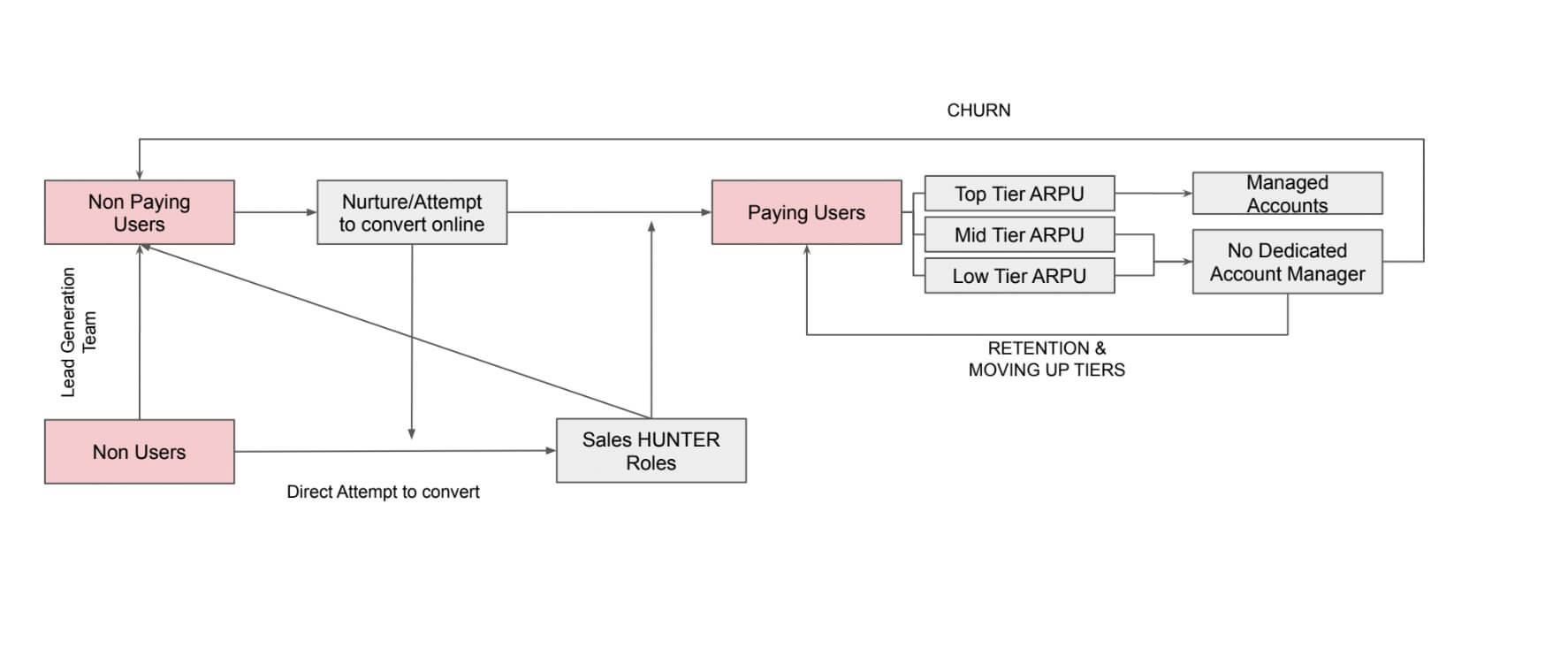
So how do you convert the old model to the newer one?
Tiers
What we did was start experimenting by looking at our current paying user base, and segmenting them in the traditional way: a pyramid.
We started looking at monthly ARPU and dividing each of our customers into the top, medium, and low tier first.
Insights
Once we did that, it gave us a very good perspective of who:
- The repeat spenders are,
- The ones that occasionally spend with us are, and
- The ones who spend with us once a year are.
That gave us a lot of insights into how to further manage them.
Segment sales
The first thing we did after dividing our customers was to divide our sales teams.
In the past, we only had a generic sales flow so we decided to again, not rocket science, take a page from the B2B book and make three different roles for our sales team.
The first one is a very simple hunter role who will get net new users or net new paying customers into the business - that part is very easy.
Dedicated onboarding team
One of the new things we added to make our customers more successful was a team of folks for onboarding these customers, in particular:
- The new customers
- The top-paying customers
In addition to onboarding, this team managed the whole lifecycle of their subscription. So regardless of whether it's a three-month, six-month, or 12-month subscription, we had dedicated people to manage these accounts just like in the B2B space – and we gave them a very personalized level of customer service.
The reason we want to give them service is not just for the sake of service, but to make them more successful on our platform.
The hypothesis is, of course, the more successful the customer, the likelier they'll stay with us.
What does managing mean?
The aim is to pass customers through the tiers, through our pyramid of segmentation.
The top tier will be managed through dedicated teams of people. The middle and low tiers will also be managed, but through digital nurture campaings.
What does managing mean, exactly? And how will this kind of management lead to better retention and up-sellcross-sell opportunities? Both in terms of moving through tiers and reducing the number of churning customers?
That's actually where we started doing a lot of the extra work.
 Daniel O’Dowd
Strategy 2: 360 degree customer dashboard
We began building 360 degree dashboards for every customer. In the past, we used to have different siloed information in different places for every customer.
For example:
- How many tickets has the customer raised?
- How many escalations has the customer done?
- How many times has the customer written to us needing help with the features, and with all the different things that they've bought from us?
- How effectively can they use these?
- What's the average revenue/what's the lifetime spending by this customer on our platform?
- What's the potential? Renewals coming up, etc.
We had these things in various different formats and under various different teams – a headache.
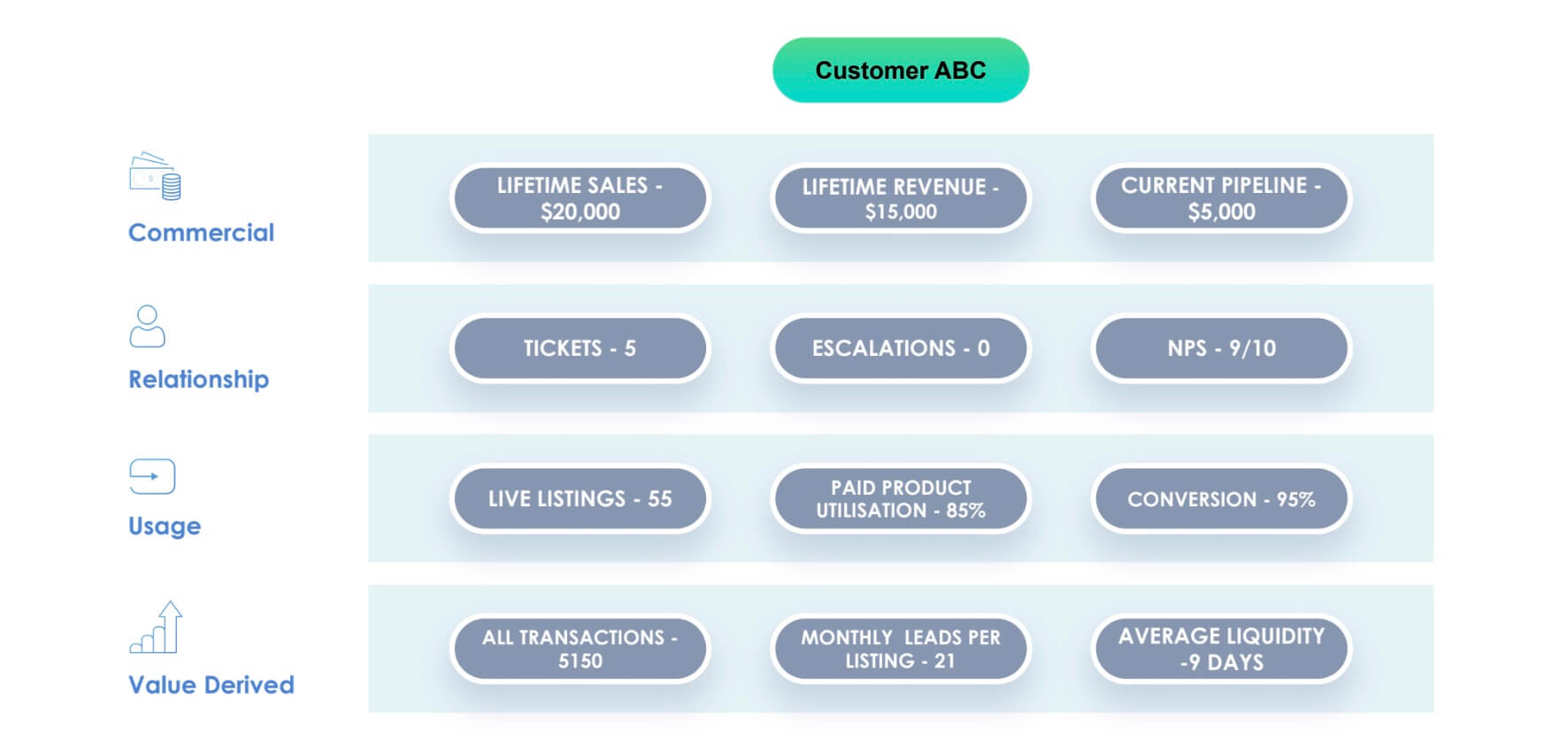
Dashboard complexity with B2C volume
Creating this 360 degree customer dashboard became extremely complex really quickly – those who understand B2C know we are talking about a mammoth list of customers here.
For example, to give you numbers, a typical account manager within our space will manage 200 customers on average, compared to a B2B counterpart who probably manages between five to 20 at most.
It's a big contrast.
Relationship/usage
When you have such a huge list of customers you cannot physically go one by one. What we did is start giving these dashboards to account managers who have meetings coming up, so that they can go in with all kinds of information around the customer’s health, relationship, or usage of the different products and services they have bought from us.
Value is key
We have to ask:
What's the value the customers are getting back for what they're paying?
This becomes extremely important in terms of customer success.
The reason we want to do all of this is simple. If a customer has purchased $1,000 worth of products or services from us, they've assigned a value to it in their mind.
They expect a certain level of return from the $1,000 that they paid for the subscription.
Transactions, leads, liquidity
What do they expect for their money? It can be in terms of the number of transactions they do, or in our case at Carousell, number of leads per listing.
When they list something, how many responses do they get back? Or we can look at it in terms of liquidity – how long does it take for them to list and then sell something? Is it 5 days, 10 days, 15 days, or 3 months?
Essentially, we started asking what the value they were getting back after buying something from us was.
This was something we hadn't looked at in the past, and we started triangulating it together as part of the 360 degree dashboards to give a full, rounded view per customer.
We moved from a sales view and a volume game, to a customer view, looking at everything – with the customer being the centre of the universe.
That’s in contrast to what we did in the past, which was just running brand new leads, and trying to sell and then move on to the next one.
B2C volume and bandwidth: How can an account manager be successful?
Having said that, even after all of these different things we did, there was still an issue of volume and bandwidth.
As I mentioned, we have close to 200 different customers assigned to every account manager.
How can this account manager still be successful? How can they still make sure they can give enough adequate priority to the right customer?
 Maggie Callahan
Strategy 3: Insight-driven customer success
This is where we further evolved this 360 degree dashboard into our final strategy. We said:
Not only are we giving you a full view, we'll also start giving you insights towards customer success
We started sending weekly help emails to all customers that have a score below 50%. We only need to look at score as either high, medium, or low. It can basically be the value or health of the overall returns the customer is getting.
Some parameters worth including can also be whether the customer is using whatever they have bought fully or not.
If they're not using it, it probably means either:
- They don't know how to do it
- They're unaware that they can do it,
- They don't know when to do it to get the best bang for their buck.
Proactive vs. reactive customer insights
Using these insights, we get a list of red flag and yellow flag customers per account manager.
With 200 accounts, they'll get maybe five or six of these thrown at them on a weekly basis.
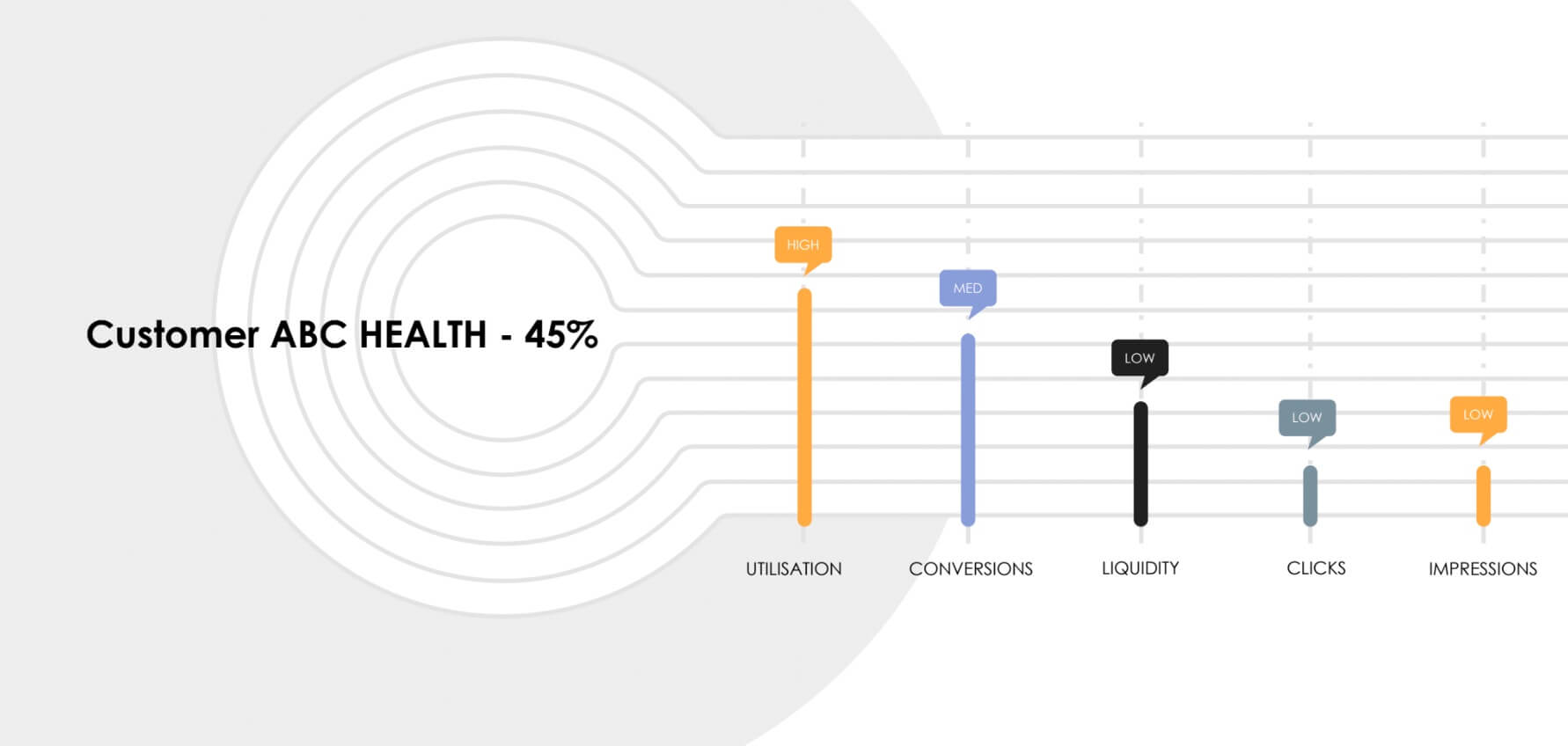
It becomes much easier then to support them, even if they're only spending an hour per day doing this specific task. It ultimately gives a very customized experience to your B2C customer, one that they aren’t used to.
Insights to increase customer success
B2C customers are used to some level of email campaigns, some level of nurture campaigns – that kind of service – but they're not used to people calling them and saying:
Oh, did you know you have been using only some of your value-added product? You've been listing these categories on these days. If you do it on these days of the week, you will have a better response or better conversions.
Or you can also tell them:
You're only using these tools right now – you're exploring paid listings because you're a virtual shop – why don't you start using one of our visual visibility products and bump yourself to the top of the queue when someone's searching a certain product or category? That way, you’ll also have better conversions, because your total current clicks on your ads or your total current liquidity seems to be very low.
Insights to improve sales success
In this way, you're not only making the customer more successful, but also making the customer success and sales teams more successful in terms of up-sell and cross-sell.
In turn, these efforts make your customers more likely to stay at the end of the subscription cycle compared to much of your competition in B2C, who are definitely not looking at human-to-human relationships.
The outcome
We've seen immense changes by following these strategies. We're not just improving our revenue but also our NPS, and the quality of customer testimonials.
We're also looking at customers that have been with us for three years and asking them how they've found interactions with us in the past compared to now.
Some of them have gone all out to say:
Oh, in the past, I used to have salespeople come up to me two days before renewal after a full year of buying something from you. But today, right from the first day I have people calling me and asking if I know how to best use whatever I bought.
Those are the high-level B2C learnings I wanted to share with you – I hope you've found them valuable!
This article is based on Vishal's presentation at our Future of Sales festival.


Sales enablement insider
Thank you for subscribing
Level up your sales enablement career & network with sales enablement experts.
An email has been successfully sent to confirm your subscription.
 Follow us on LinkedIn


.svg)

Start the conversation
Become a member of Sales Enablement Collective to start commenting.
Sign up now